TONY HAYWARD
↓
TONY HAYWARD
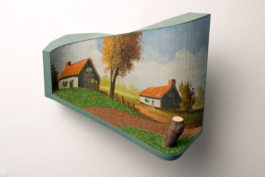
Tony Hayward, Stump (2005)
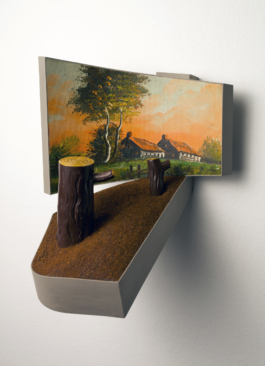
Tony Hayward, Two Stumps (2009-10)
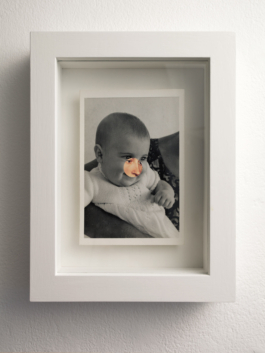
Tony Hayward, Baby (2010)
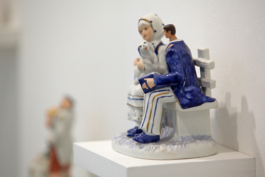
Tony Hayward, Park Bench from the Loving Couples series (2010)
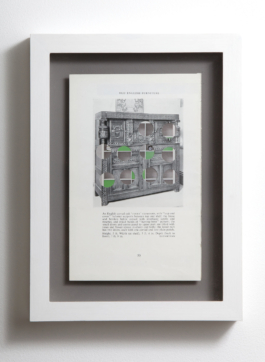
Tony Hayward, Old English Furniture: page 50 (2014)
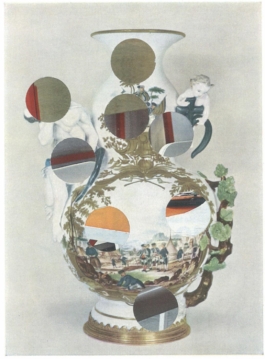
Tony Hayward, A Runts Vase (2020)
Tony Hayward's wall pieces reveal an affection for interests currently found within popular culture and ideas around landscape. The artist subverts found cliched landscapes to create playful 3D vistas which explore subtexts and hint at stories behind bucolic scenes. He enjoys juxtaposing themes such as a felled tree, a cave for a hermit, and a not-so-cosy cottage within the pastoral. These are a few of the ingredients as he explores the idea of the miniature, the overlooked and the cast-off.
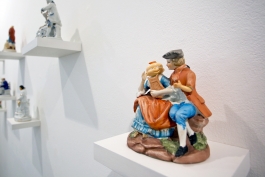
His ‘Loving Couples’ porcelain figurines originate from a similar source as he ‘restores’ damaged second-hand artefacts by adding a replacement head to upset and reinvent the sentiments of a piece. In a collection of his most recent 2-D collages he uses a large hole-punch to remove part of a found image, replacing the lost section with one from an unrelated image to create unnerving works rich with surprising poetic tensions.
Hayward studied Sculpture at Saint Martins School of Art and Ceramics at the Royal College of Art. He has exhibited widely in the UK including shows at Victoria Miro Gallery, Flowers East and Whitechapel Art Gallery, as well as in the USA, Netherlands, Belgium and the Czech Republic. His work also features in various public collections including the British Council and Unilever. He travels frequently to India and has formed a collection of recycled artefacts, which have generated a number of publications including Made in India and Indian Rat Traps. He also lectures at the Royal College of Art and Camberwell College of Arts and runs regular creative workshops for children.
TONY HAYWARD
Tony Hayward, Stump (2005)
Tony Hayward, Two Stumps (2009-10)
Tony Hayward, Baby (2010)
Tony Hayward, Park Bench from the Loving Couples series (2010)
Tony Hayward, Old English Furniture: page 50 (2014)
Tony Hayward, A Runts Vase (2020)
Tony Hayward's wall pieces reveal an affection for interests currently found within popular culture and ideas around landscape. The artist subverts found cliched landscapes to create playful 3D vistas which explore subtexts and hint at stories behind bucolic scenes. He enjoys juxtaposing themes such as a felled tree, a cave for a hermit, and a not-so-cosy cottage within the pastoral. These are a few of the ingredients as he explores the idea of the miniature, the overlooked and the cast-off.
His ‘Loving Couples’ porcelain figurines originate from a similar source as he ‘restores’ damaged second-hand artefacts by adding a replacement head to upset and reinvent the sentiments of a piece. In a collection of his most recent 2-D collages he uses a large hole-punch to remove part of a found image, replacing the lost section with one from an unrelated image to create unnerving works rich with surprising poetic tensions.
Hayward studied Sculpture at Saint Martins School of Art and Ceramics at the Royal College of Art. He has exhibited widely in the UK including shows at Victoria Miro Gallery, Flowers East and Whitechapel Art Gallery, as well as in the USA, Netherlands, Belgium and the Czech Republic. His work also features in various public collections including the British Council and Unilever. He travels frequently to India and has formed a collection of recycled artefacts, which have generated a number of publications including Made in India and Indian Rat Traps. He also lectures at the Royal College of Art and Camberwell College of Arts and runs regular creative workshops for children.
MARSDEN WOO
All photography © Philip Sayer unless otherwise attributed.
This site contains images of work protected by copyright. We do not consent to reproduction or use of any images without our consent including for the purposes of AI training.
MARSDEN WOO
info@marsdenwoo.com
i @marsden_woo
Subscribe to our mailing list
All photography © Philip Sayer unless otherwise attributed.
This site contains images of work protected by copyright. We do not consent to reproduction or use of any images without our consent including for the purposes of AI training.